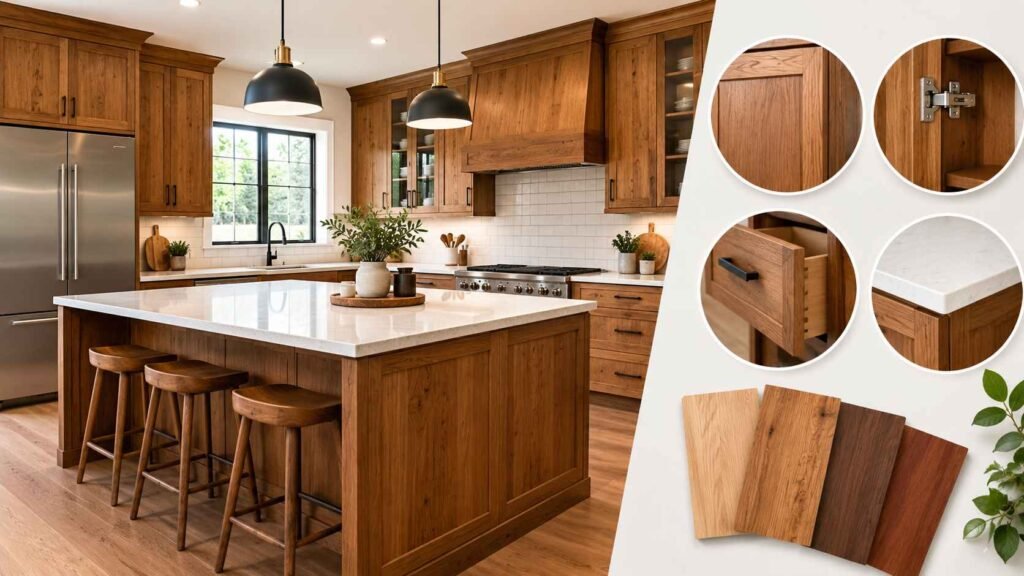
When remodeling a kitchen, cabinets are one of the biggest decisions you will make. They affect the appearance of the room, how much storage you have, how well the kitchen functions, and a significant part of your renovation budget. Real Wood Kitchen Cabinets remain a popular choice because they bring natural character, durability, and a timeless appearance that can work with both traditional and modern designs.
But are they actually worth the higher price? What type of wood should you choose? And does “real wood” mean the entire cabinet is made from solid hardwood?
The answer is more complicated than simply choosing the most expensive material. The best Wood Cabinets for Your Kitchen depend on your budget, design preferences, cooking habits, maintenance expectations, and the conditions inside your kitchen.
In this guide, we’ll explain the advantages and disadvantages of real wood cabinets, compare popular wood species, discuss what affects the cost of Solid Wood Kitchen Cabinets, and help you decide which option makes the most sense for your home.
What Are Real Wood Kitchen Cabinets?
Real wood kitchen cabinets are cabinets that use natural wood as a significant part of their construction, particularly for doors, drawer fronts, face frames, and sometimes cabinet boxes.
However, there is an important distinction between solid wood and wood veneer.
Solid wood is made from natural lumber. A cabinet door made from solid maple, oak, cherry, or another hardwood contains genuine wood throughout the main component. Wood veneer, on the other hand, uses a thin layer of real wood over another material.
This distinction matters when comparing Wood Cabinets for Your Kitchen because two cabinets may look almost identical while having very different construction, durability, and prices.
High-quality cabinetry can also combine materials. For example, a manufacturer may use solid hardwood for the doors and face frames while using plywood or another engineered material for the cabinet box. That does not automatically make the cabinet poor quality.
In fact, the construction of the entire cabinet can be just as important as the species of kitchen cabinet wood you select.
Why Choose Real Wood Kitchen Cabinets?
The biggest attraction of real wood is its natural appearance. Unlike printed surfaces designed to imitate wood, genuine wood has variations in grain, color, texture, and markings.
These characteristics make every cabinet slightly different.
Natural Beauty That Ages Well
One of the strongest reasons homeowners choose Real Wood Kitchen Cabinets is their appearance.
Oak can provide a prominent grain, maple offers a relatively smooth and consistent look, cherry develops richer tones as it ages, while walnut is known for its darker and more luxurious appearance.
Natural variations such as knots, mineral streaks, and differences in grain are not necessarily defects. They are characteristics of genuine wood.
Wood can also change gradually with age and exposure to light. Certain species, particularly cherry, can become darker and richer over time.
Excellent Durability
Quality hardwood is strong enough to handle the daily activity of a busy kitchen.
Cabinet doors are opened and closed repeatedly, drawers carry cookware and dishes, and surfaces are exposed to occasional bumps and scratches. Harder wood species can provide excellent resistance to everyday wear.
For example, hickory is particularly hard and strong, while maple and oak also offer substantial durability.
However, durability depends on more than the species. Joinery, construction quality, finish, hardware, installation, and maintenance all contribute to how long a cabinet performs well.
Can Be Refinished
Another advantage of Solid Wood Kitchen Cabinets is that many solid-wood surfaces can be sanded, stained, or refinished.
This gives homeowners more flexibility over the long term.
If your kitchen style changes several years from now, you may not need to replace the cabinets simply because you dislike the existing color. Depending on the cabinet’s construction and finish, refinishing can give the kitchen a completely different appearance.
That ability to repair and refresh natural wood is one reason wood cabinetry can remain attractive for many years.
The Disadvantages of Real Wood Kitchen Cabinets
Real wood is not perfect. The natural characteristics that make it attractive can also create challenges.
Higher Upfront Cost
The first major drawback is price.
Solid Wood Kitchen Cabinets generally cost more than many budget-oriented cabinet materials. Current 2026 estimates vary considerably, but solid-wood cabinetry can commonly fall around $300-$700 or more per linear foot, with custom cabinetry potentially reaching $1,200+ per linear foot depending on construction, species, design, and location.
A complete kitchen can therefore represent a substantial investment.
Keep in mind that cabinet prices may not include installation, demolition, countertops, appliances, plumbing, electrical work, or other remodeling expenses.
For that reason, never compare cabinet quotes based only on the headline price.
Wood Responds to Moisture and Humidity
Natural wood is a living material in the sense that it responds to its environment.
Changes in humidity can cause wood to expand and contract. Over time, significant changes in moisture conditions can contribute to movement, cracking, or warping.
This does not mean wood cabinets cannot be used in kitchens. They absolutely can.
It means they need appropriate construction, a quality finish, and sensible care. Areas around sinks, dishwashers, and other moisture sources deserve particular attention.
Natural Imperfections Are Part of the Look
If you want every cabinet door to have exactly the same grain and color, natural wood may not be the best choice.
Real lumber naturally varies.
One door may contain a darker streak while another may have a slightly different grain pattern. Some species have visible knots or other natural markings.
For some homeowners, this is precisely what makes Wood Cabinets for Your Kitchen attractive. For others, a highly uniform manufactured surface may be preferable.
Best Types of Kitchen Cabinet Wood
Choosing the right kitchen cabinet wood is about more than picking the species that looks best in a photograph.
Think about the appearance you want, whether you plan to paint or stain the cabinets, how much wear they will receive, and your overall budget.
Maple
Maple is a popular choice for homeowners who want a relatively smooth and consistent appearance.
It generally has a light, creamy color and fine grain. Its relatively uniform surface makes it suitable for both stained and painted applications.
Maple can be an excellent option for contemporary kitchens where you want the cabinets to look clean without an extremely dramatic grain pattern.
If you are looking for versatile Wood Cabinets for Your Kitchen, maple deserves serious consideration.
Oak
Oak is known for its recognizable grain and strong appearance.
It works particularly well when you want the natural wood pattern to remain visible rather than being hidden under a heavy paint finish.
White oak has become particularly popular in modern kitchen designs because of its lighter appearance and distinctive grain.
Oak is also a durable hardwood, making it a practical option for frequently used kitchens.
Cherry
Cherry provides warmer tones and a refined appearance.
Its color can range from lighter tones to deeper reddish-brown shades, and it can become darker or richer with age and light exposure.
Cherry is especially appealing if you want cabinetry with a traditional or elegant appearance.
Because its color can change naturally over time, homeowners should understand that the cabinets may not look exactly the same years after installation.
Hickory
If durability and visual character are priorities, hickory is worth considering.
It is very hard and strong, with dramatic variations between lighter and darker areas.
That variation gives hickory a distinctive rustic appearance.
However, its pronounced grain and color differences may not appeal to someone looking for a perfectly uniform kitchen.
Walnut
Walnut is valued for its rich, darker appearance and relatively fine grain.
It can create an upscale look without requiring an elaborate door design. Walnut typically costs more than many mainstream cabinet woods, so it is generally better suited to homeowners with a larger cabinetry budget.
If your goal is a warm, sophisticated kitchen where the natural material is part of the visual focus, walnut can be an excellent choice.
How Much Do Real Wood Kitchen Cabinets Cost?
There is no single price for Real Wood Kitchen Cabinets because several variables influence the final quote.
The size of the kitchen is one of the biggest factors. A kitchen with 15 linear feet of cabinetry will naturally require less material and labor than a large kitchen with 40 linear feet, an island, tall pantry cabinets, and additional storage.
Cabinet construction also matters.
Stock, semi-custom, and fully custom cabinets occupy different price ranges. Custom cabinetry costs more because the cabinets are designed and built around specific measurements, layouts, materials, and features. Current 2026 estimates place custom cabinetry broadly in the hundreds of dollars per linear foot, with premium custom projects potentially exceeding $1,000 per linear foot.
The wood species also affects the price, as do door style, finish, drawer construction, hardware, decorative details, and interior accessories.
A Practical Way to Think About Your Budget
Instead of asking only, “How much do wood cabinets cost?” ask what is included in the quotation.
A $10,000 cabinet quote and a $10,000 installed project are not necessarily equivalent.
One may include delivery and installation while another may cover cabinetry only.
You should also ask whether the quote includes hardware, finishing, fillers, trim, crown molding, panels, and modifications required for appliances.
This is particularly important when comparing Solid Wood Kitchen Cabinets from different suppliers.
Solid Wood vs. Wood Veneer: Which Is Better?
The choice between solid wood and veneer is not as simple as “solid is always better.”
Solid wood has the advantage of being genuine lumber throughout the primary solid component and can often be repaired or refinished. However, it is also more expensive and naturally responds to humidity.
Wood veneer uses a thin layer of real wood over a core material. It can provide the appearance of genuine wood while using less hardwood, and it can be more dimensionally stable in some applications.
A well-built cabinet using a combination of materials can therefore be a perfectly sensible choice.
When evaluating Wood Cabinets for Your Kitchen, look at the complete construction rather than assuming the word “solid” automatically tells you everything about quality.
How to Choose the Best Wood Cabinets for Your Kitchen
Start with your kitchen’s overall design.
If you want a clean, contemporary appearance, maple or white oak may suit the space well. If you prefer a traditional or warmer design, cherry or walnut may be more appropriate. If you want a rustic look with dramatic natural variation, hickory can provide plenty of character.
Next, think about the finish.
Do you want to see the natural grain? A stain or clear finish can emphasize the characteristics of the kitchen cabinet wood. If you want a painted appearance, a finer-grained species may provide a smoother visual result.
Finally, consider how heavily the kitchen will be used.
A busy family kitchen should prioritize durable construction, quality hardware, and a finish appropriate for daily use. A rarely used secondary kitchen may not justify the same investment.
The best Wood Cabinets for Your Kitchen are not necessarily the most expensive ones. They are the ones that provide the right combination of appearance, performance, construction, and value for your particular space.
How to Maintain Real Wood Kitchen Cabinets
Proper maintenance can help preserve the appearance of Real Wood Kitchen Cabinets for years.
Wipe spills rather than allowing moisture to sit on the surface. Use gentle cleaning methods appropriate for the cabinet’s finish, and avoid abrasive products that can damage the protective coating.
Pay particular attention to areas near the sink and dishwasher.
Humidity also matters. Because natural wood responds to moisture changes, maintaining reasonably stable indoor conditions can help reduce unnecessary movement.
If a cabinet develops a small scratch or surface imperfection, address it rather than allowing the damage to worsen.
One of the benefits of Solid Wood Kitchen Cabinets is that certain surfaces can be repaired or refinished rather than automatically replaced.
Are Real Wood Kitchen Cabinets Worth It?
For many homeowners, yes.
But the value depends on what you expect from your kitchen.
If you want natural beauty, long-term durability, repairability, and a material that can develop character with age, Real Wood Kitchen Cabinets can be an excellent investment.
If your priority is minimizing the initial renovation cost, there may be more economical materials worth considering.
There is also no rule saying every component of your kitchen must be made from solid hardwood. A thoughtfully constructed cabinet can combine solid wood, veneer, plywood, and other materials to achieve a balance between performance and cost.
The key is understanding exactly what you are buying.
Final Thoughts on Real Wood Kitchen Cabinets
Choosing cabinets is one of the most important decisions in a kitchen remodel, and real wood remains popular for good reason. Its natural grain, durability, repairability, and timeless appearance can make a kitchen feel warmer and more substantial.
However, Real Wood Kitchen Cabinets require a larger investment than many alternatives, and natural wood needs appropriate care. The right choice ultimately comes down to your budget, kitchen environment, preferred style, and expectations for long-term performance.
Whether you are considering maple, oak, cherry, hickory, or walnut, take time to compare the wood, construction, finish, hardware, warranty, installation, and total project cost rather than judging cabinets by appearance alone.
FAQs
1. Are real wood kitchen cabinets worth the money?
Real wood kitchen cabinets can be worth the investment if you value natural appearance, durability, repairability, and long-term use. They generally cost more upfront, so the decision should be based on your budget and how long you expect to keep the kitchen.
2. What is the best kitchen cabinet wood?
There is no single best kitchen cabinet wood for every kitchen. Maple is versatile and relatively uniform, oak provides distinctive grain and durability, cherry offers warm tones, hickory provides dramatic variation and strength, and walnut creates a rich, premium appearance. Your ideal choice depends on your design and budget.
3. Are Solid Wood Kitchen Cabinets waterproof?
No. Solid Wood Kitchen Cabinets are not waterproof. Natural wood can absorb moisture and respond to changes in humidity. A quality finish helps protect the surface, but spills should still be cleaned promptly, and prolonged exposure to water should be avoided.
4. How long do Real Wood Kitchen Cabinets last?
Well-built Real Wood Kitchen Cabinets can provide many years of service, particularly when they are properly installed and maintained. Their actual lifespan depends on construction quality, wood species, finish, kitchen conditions, and everyday use.
5. Can Wood Cabinets for Your Kitchen be refinished?
Many solid wood cabinet components can be sanded, stained, painted, or otherwise refinished, depending on their construction and existing finish. This is one of the major advantages of choosing natural wood because you may be able to update the appearance without replacing the entire cabinet system.